- Payment Options
- Terms Conditions
- Malibu 453 blv
- info@charity.com



[Her journey map can support this evidence]
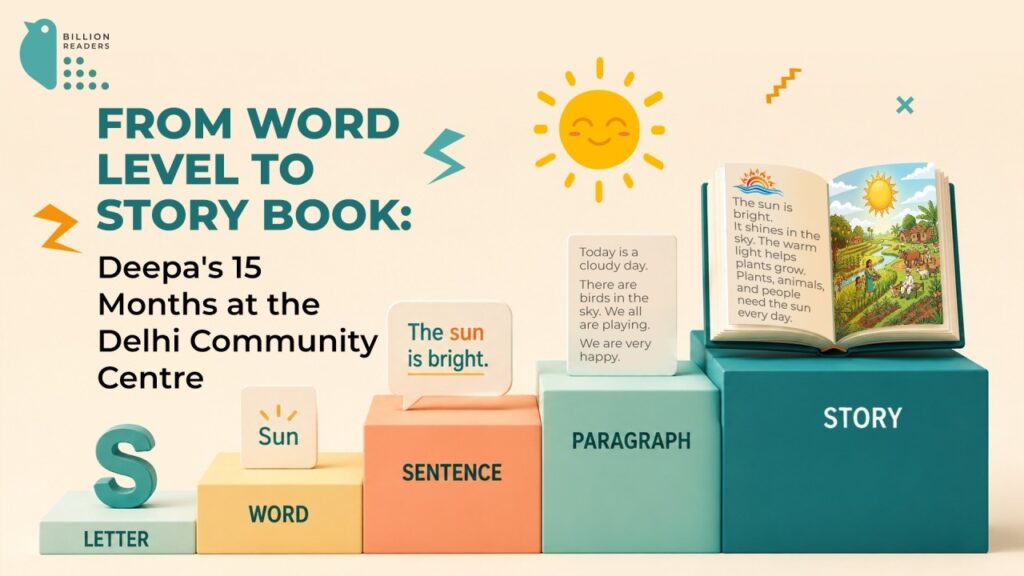
Deepa first walked into our Community Learning Centre in Sunlight Colony, Delhi in November 2024. She was in grade 7 and twelve years into her schooling life. She was reading at the Word level, as per the Do-It-Yourself ASER test, in both Hindi and English.
Let that sit for a moment. Word level. That means being able to read some individual words like cat, sun, bed in isolation, but not sentences. Not paragraphs. Not a story. She was two years away from secondary school, and the gap between her actual grade and the grade level that she was reading at had been quietly growing for years. The nearby government school that she went to had either not caught it or had not known what to do with it.
Deepa did not wear this gap loudly. Our observation notes early on describe her as willing, interactive, and always present. She participated in group discussions. She raised her hand. She said yes when asked if she understood. But when asked to read a simple English or Hindi sentence on her own, without support, she could not. The understanding she projected in group settings was partly borrowed from context, from her peers, from the safety of not being tested alone.
This is a common but rarely discussed pattern: children who have learned to navigate classrooms without being able to read.
What the Centre Did Differently
Our Learning Centre was not a tuition class. There were no grades, no marks, and no one got in trouble for reading slowly. What it did have was a smart TV, access to our BookBox YouTube channel, and a facilitator who carefully observed the change in reading patterns of children who come from the nearby low-income communities.
The core intervention is Same Language Subtitling (SLS). Children watch engaging story videos and educational content with subtitles in the language of the audio, running at the bottom of the screen. The animation pulls them in. The subtitles pull their eyes to the text. Nobody tells them they have to read. But they do, because the story is happening right there on screen and they want to know what comes next.
For Deepa, this mattered. The early session notes record her watching SLS videos and understanding the context. She followed the story, answered questions correctly after viewing, and made connections to things she knew. What the subtitles were doing, quietly, was reintroducing her to practice reading text in a low-pressure environment.
Alongside SLS sessions, the facilitator maintained daily observation and reflection logs, handwritten records of what Deepa did, how she responded to questions, where she got stuck, and what to try next. These notes became the architecture of Deepa’s individual learning plan. When Deepa struggled with independent reading and sentence framing even after understanding the content, the plan shifted: oral response first, written second. When she struggled with English decoding, the plan introduced simpler sentences, more visual support, and pre-taught vocabulary before asking her to read.
The approach was not linear. Some sessions she needed everything explained again from the beginning. Some sessions she surprised everyone.
What Changed — And How We Know That
Deepa attended the centre for fifteen months. Of the 81 children documented across the programme, she is among the longest-enrolled — and her trajectory shows what sustained engagement with SLS can produce.
At the start: Word level in both English and Hindi. Three months in, she was reading at the paragraph level in both Hindi and English. Six months in, she was reading at the Story level in Hindi and maintained the Paragraph level in English. By the time she exited:
Paragraph level in English. Story level in Hindi.
Story level means she can read a short story independently, with comprehension. In Hindi, she got there. In English — a language she had almost no exposure to outside the centre — she reached Paragraph, reading and understanding multi-sentence text on her own. She is closer towards reading at story level.
While the ASER baseline and endline, done by our team in a span of every three months, tell us where she is at, they do not necessarily capture the full essence of the change. The observation notes as well as the analysis of her natural reading give us a deeper insight, in addition to the ASER results.
In the early months, Deepa needed full guided support for every reading task. She was attentive but passive — absorbing what was explained without being able to apply it independently. She would say she understood when she did not, not out of dishonesty but because of how she had learnt to navigate the environment at school. By March 2026, the notes read differently. Deepa chose storybooks from the library herself — without being asked. She read them. When she encountered difficult words, she wrote them down. She tried to guess the meanings before asking. She used new words in conversation.
That shift — from passive attendance to active, self-directed reading — is what three months of low-pressure, same language subtitle-supported learning produced.
Why Deepa’s Story Matters for the Bigger Picture
There are millions of children in India who look, on paper, like they are learning. They are enrolled in school. They attend school. They are promoted from one class to the next. And yet many of them cannot read the textbooks in front of them.
This is not a new finding. ASER’s annual reports have documented it for two decades. What is still rare is a clear, replicable, low-cost model for what to do about it — one that works in a community room with a television, does not require a trained reading specialist, and can hold the attention of a 12-year-old who has already had years of schooling that did not work for her.
Deepa’s journey at the Delhi Community Centre facilitated by BIRD@PlanetRead is evidence that such a model could work. SLS worked for her not only because it was safe. It also gave her repeated, joyful encounters with text without asking her to perform competence she had not yet built. It let comprehension lead, and let reading follow.
The Delhi Community Centre is one centre. Deepa is one child. But the model is documented, the approach is replicable, and the results are real. That is where scale begins. And children like Deepa are why we do this work.
Deepa’s name has been shared with her and her father’s knowledge as part of the programme’s documentation. The Delhi Community Centre operated from July 2024 to April 2026 under the SLS-BIRD initiative in Bhagwan Nagar, Sunlight Colony, New Delhi.
Researcher – Gender & Media




Leave a Reply